The promise of smart home security has long outpaced its delivery. A generation of motion sensors, door contacts, and basic cameras has given households a system that alerts them to almost everything — a passing car, blowing curtains, a family pet — while routinely missing the events that actually matter. The result is alert fatigue: homeowners who disable notifications because the false alarm rate makes them useless, leaving homes genuinely unprotected. AI-powered home monitoring represents a fundamental departure from this pattern.
Where traditional systems detect motion without understanding it, AI systems understand context. They can distinguish between a family member returning home and an unrecognised individual. They can tell the difference between a child playing and a child in distress. They can recognise the characteristic posture of an elderly person falling versus simply sitting down. This contextual intelligence is what transforms a camera network from a passive recording device into a genuinely protective home monitoring system.
Why Traditional Home Security Falls Short
The fundamental limitation of traditional home security is that it is binary: something moved, or it did not. PIR (passive infrared) motion sensors detect heat signatures crossing their field of view. Standard cameras record footage that must be reviewed after an event. Neither system has any capacity to interpret what is happening — to assess whether detected motion represents a threat, a routine activity, or a family member who needs help.
This creates two failure modes. The first is over-alerting: the homeowner receives dozens of notifications per day for cars passing, trees moving in wind, or pets walking through a room. After a few days of this, most people either turn off notifications or become so desensitised that real alerts are ignored. The second failure mode is under-detection: the system fails to distinguish a genuine intrusion from normal background activity, or misses entirely the kind of welfare events — falls, medical emergencies — that matter most to families with vulnerable household members.
AI systems trained on large datasets of labelled home activity learn to recognise the difference between these scenarios with high confidence. The result is a dramatic reduction in false alarms and a simultaneous improvement in genuine event detection.
Contextual AI: Understanding What Is Actually Happening
Modern AI home monitoring platforms like KenHome use computer vision models that classify not just the presence of movement but the nature of the activity being performed. The system learns the normal patterns of household activity — when people typically arrive and depart, which rooms are used at which times, what the movement patterns of regular occupants look like — and uses this baseline to identify genuine anomalies.
Key contextual detection capabilities include:
- Person recognition: Distinguishing between recognised household members and unfamiliar individuals, enabling differentiated responses for family arrivals versus potential intrusions
- Activity classification: Identifying specific activities such as package delivery, vehicle approach, or loitering versus normal pedestrian traffic
- Temporal anomaly detection: Flagging activity that occurs at unusual times relative to the household's normal schedule — movement in a room that is normally empty at night, for example
- Zone-based rules: Applying different alerting logic to different areas — high sensitivity for rear entry points, lower sensitivity for front garden where delivery and visitor activity is expected
"AI home monitoring platforms reduce false alarm rates by over 90% compared to traditional motion sensors — while catching genuine safety events that simpler systems miss entirely."
Elder Care: Detecting Falls Before They Become Emergencies
For families with elderly relatives living independently, the gap between what traditional security systems offer and what is actually needed is most stark. A motion sensor cannot tell whether an elderly person has simply moved from one room to another or has fallen and is unable to get up. A basic camera records footage but sends no alert. By the time a family member calls to check in and receives no answer, precious time has already been lost.
AI fall detection systems address this directly. Models trained on thousands of annotated examples of fall events — the characteristic rapid downward movement, the prone position on the floor, the absence of subsequent self-righting movement — can detect a fall within seconds of its occurrence and generate an immediate alert to designated family members or emergency contacts. The system distinguishes genuine falls from intentional floor activities such as stretching or playing with grandchildren, significantly reducing false alerts that would cause alarm fatigue.
Activity Monitoring for Wellness Insights
Beyond fall detection, AI home monitoring provides longitudinal wellness insights that have genuine clinical value for elder care. Gradual changes in mobility patterns, sleep duration, kitchen usage frequency, and bathroom visit patterns can all be indicators of declining health that are invisible to family members who visit infrequently. AI platforms that track these patterns over weeks and months can alert family caregivers to statistically significant changes in daily activity that warrant a welfare check or medical consultation — before a crisis develops.
Child and Pet Monitoring Without Surveillance Overload
Parents of young children navigate a difficult balance: they want assurance that their child is safe without conducting constant surveillance. AI home monitoring shifts this balance by monitoring for specific safety-relevant events rather than providing a continuous video feed that parents feel obligated to watch.
For children, the system can be configured to alert parents when a child enters defined danger zones — pool areas, staircases, driveways — without generating alerts for normal indoor activity. For infants, AI sleep monitoring detects abnormal movement patterns or extended periods without expected movement, providing a layer of safety monitoring without replacing proper safe-sleep practices.
Pet monitoring benefits from the same contextual intelligence. The system learns what the household's pet looks like and how it moves, and can distinguish pet activity from human intrusions in camera-covered areas. This eliminates the false alert problem that makes traditional motion sensor-based systems unusable in homes with pets — a significant population of households that has historically been poorly served by security technology.
See how KenHome protects families with context-aware AI
Explore KenHome →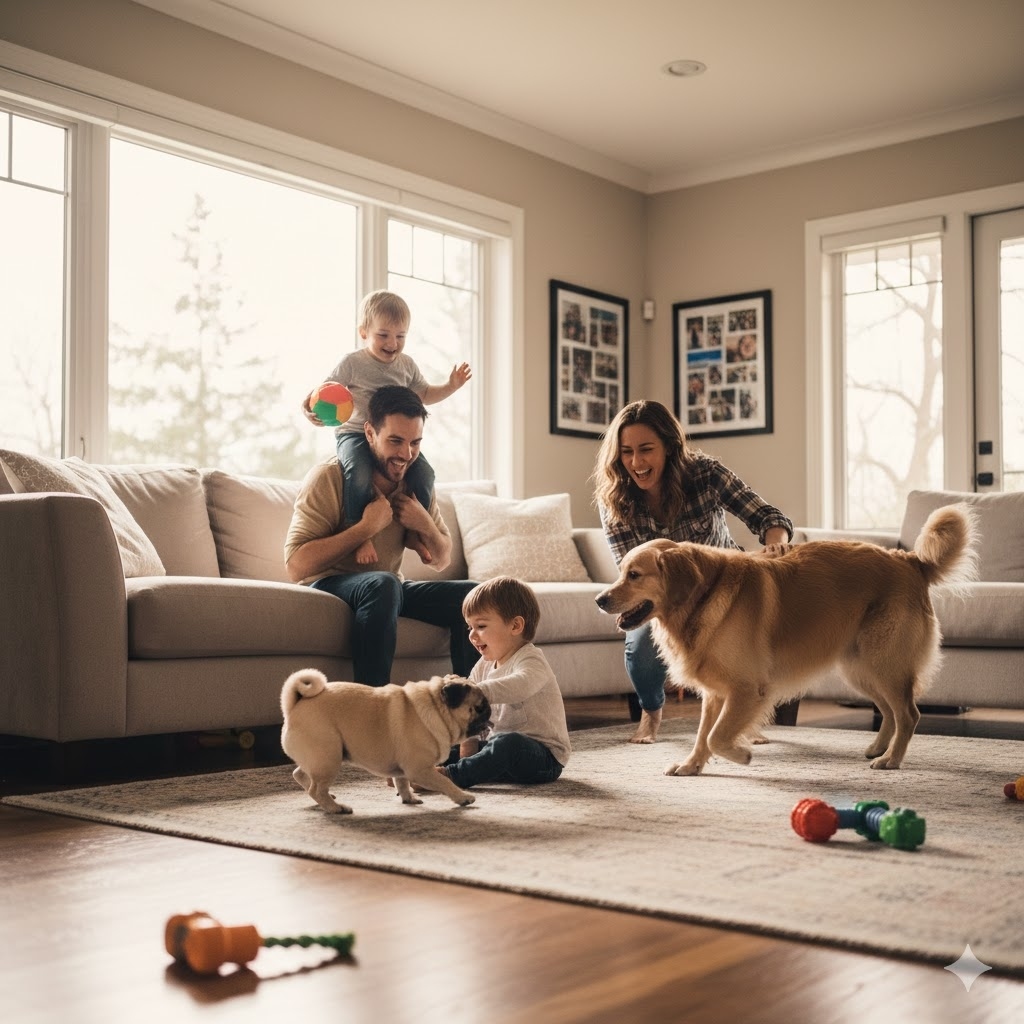
Getting Started with AI Home Security
The most important step in evaluating AI home monitoring is to identify the specific use cases that matter most for your household. The needs of a family with young children differ significantly from those of adult children monitoring an elderly parent living alone, which differ again from a homeowner primarily interested in perimeter security. Matching the system configuration to the priority use cases delivers the best experience and avoids the complexity of deploying features that are not relevant to your situation.
Hardware requirements for AI home monitoring are modest by commercial standards. Most deployments use standard indoor and outdoor IP cameras with sufficient resolution (typically 1080p or higher) and reasonable field of view to cover the areas of interest. Edge processing options mean that sensitive household data can be processed locally without transmitting video to cloud servers — an important consideration for households with privacy concerns about continuous home monitoring.
- Start with your highest-priority use case. Whether that is fall detection for an elderly resident or perimeter intrusion detection, configuring one use case well is more valuable than deploying all features at minimum quality
- Review alert thresholds during the first two weeks. AI systems benefit from tuning against the specific lighting conditions, household routines, and camera positions of your home before finalising sensitivity settings
- Communicate with all household members. AI monitoring is most effective when all residents understand what it detects and what it does not — and when the alert routing reaches the right people reliably
- Consider privacy preferences for each camera zone. Most platforms support scheduled privacy modes and on-demand camera muting for zones where occupants prefer not to be monitored during specific periods
The fundamental difference between AI home monitoring and traditional security is not the cameras — it is the understanding of what those cameras see. For families with diverse monitoring needs, that understanding is the difference between a system that creates anxiety and one that genuinely provides peace of mind.