Every year, hundreds of thousands of workers are injured in preventable workplace accidents. In construction alone, falls, struck-by incidents, and equipment-related injuries account for the majority of fatalities. Despite decades of safety regulation, incident rates have stagnated in many industries — not because safety culture is lacking, but because human supervision simply cannot maintain continuous vigilance across an entire job site or facility floor simultaneously. AI-powered real-time safety monitoring changes that equation fundamentally.
Modern AI safety platforms use computer vision to continuously analyse video feeds from existing cameras, detecting hazards, compliance failures, and dangerous behaviours the moment they occur — and alerting supervisors before an incident happens. The shift from reactive incident investigation to proactive hazard intervention is transforming occupational health and safety programmes across construction, manufacturing, and industrial logistics.
The Human and Financial Cost of Workplace Accidents
The human cost of workplace accidents is immeasurable, but the economic case for prevention is equally compelling. According to industry estimates, a single lost-time injury can cost an employer between $30,000 and $150,000 once medical costs, compensation, productivity loss, and regulatory penalties are factored in. Fatalities carry significantly higher costs — legal, financial, and reputational. For large construction firms managing multiple active sites, the aggregate exposure runs into millions of dollars annually.
Regulatory pressure is also intensifying. Occupational safety authorities in Canada, the United States, and the European Union have increased inspection frequencies and fine schedules for repeated violations. Demonstrating proactive compliance — not just responding to incidents after the fact — is becoming a requirement for contract eligibility on major public and private construction projects.
AI safety monitoring provides the documented evidence of compliance and the systematic violation detection that safety officers and regulators increasingly expect to see.
How AI Detects Safety Violations in Real Time
AI safety platforms like KenSafety process live camera feeds through computer vision models trained to recognise specific safety-relevant events. The system continuously analyses every frame across every camera, performing detections that include:
- PPE non-compliance: Identifying workers missing hard hats, high-visibility vests, safety glasses, gloves, or steel-toed boots in designated mandatory zones
- Restricted zone violations: Detecting personnel entering exclusion zones around heavy machinery, excavations, or energised electrical equipment
- Unsafe proximity events: Flagging workers who come within critical distance of moving vehicles, crane swing radii, or operating heavy equipment
- Posture and ergonomic risk: Identifying manual handling activities that present musculoskeletal injury risk in warehouse and manufacturing settings
- Fire and smoke detection: Early identification of fire hazards before alarms trigger, enabling faster evacuation response
- Spill and slip hazard detection: Recognising liquid spills or debris on walkways that create fall risks
When a violation is detected, the system generates an alert — typically delivered to a supervisor's mobile device or control room dashboard within seconds — with a timestamped image capture and location reference. This allows immediate intervention rather than post-incident investigation.
"Construction sites using AI safety monitoring report a 4× faster hazard response time and up to 68% reduction in PPE violations within the first quarter."
PPE Compliance at Scale
PPE compliance is one of the most persistent challenges in occupational safety management. On a busy construction site with dozens or hundreds of workers across multiple zones, it is physically impossible for safety officers to monitor PPE adherence continuously. Manual spot checks create compliance theatre — workers comply when observed and revert when the supervisor moves on.
AI monitoring eliminates this dynamic by providing continuous, impartial detection across all camera-covered zones simultaneously. Because every worker knows the system is always watching — and that violations generate an immediate supervisor notification — compliance behaviour changes durably rather than situationally. The deterrent effect typically produces significant reductions in violations within the first two to four weeks of deployment, without requiring additional safety headcount.
Configurable Compliance Zones
Advanced platforms allow safety managers to define different PPE requirements for different zones within a site. A welding area may require face shields and flame-resistant clothing in addition to standard PPE, while a general access corridor may only require hard hats and vests. AI models can be configured per zone, eliminating false alerts in areas where specific items are not required and focusing enforcement precisely where it matters.
Beyond Cameras: Integrating IoT Sensors
Video analytics provides rich contextual detection, but integrated IoT sensor networks amplify its effectiveness. Modern safety platforms combine visual AI with environmental sensor data to create a more complete safety picture:
- Gas and air quality sensors detect hazardous atmospheric conditions in confined spaces, underground work areas, and chemical handling zones before workers are exposed
- Wearable proximity tags track worker locations relative to machine operating envelopes, triggering alerts when personnel enter hazardous zones not covered by cameras
- Vibration and noise sensors on machinery provide early warning of mechanical failure that could create sudden hazards
- Environmental condition monitors track temperature, humidity, and wind speed on exposed sites to enable heat stress and weather-risk alerts
When sensor data is fused with AI video analysis, the platform can distinguish genuinely dangerous situations from false positives with much higher confidence. A camera detecting a worker near a machine perimeter is much more actionable when a proximity sensor simultaneously confirms the machine is in active operation.
See how KenSafety monitors construction and industrial sites
Explore KenSafety →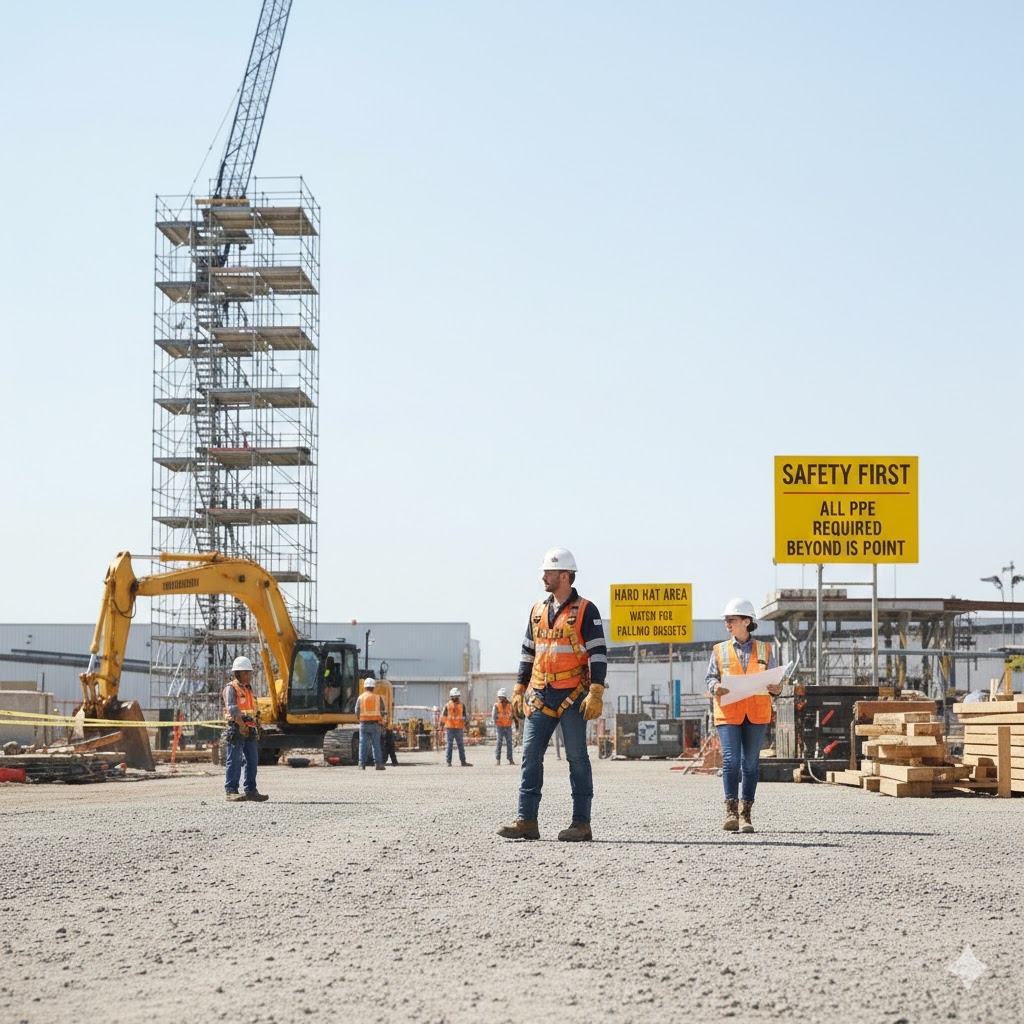
Implementing an AI Safety Platform
Most AI safety deployments can leverage existing camera infrastructure, significantly reducing upfront cost. The implementation process typically follows four stages:
- Site assessment and camera audit: Mapping existing camera positions against safety-critical zones and identifying coverage gaps that require additional cameras or sensor placements
- Model configuration: Configuring detection models for the specific hazard types, PPE requirements, and zone boundaries that apply to the site
- Integration and alerting setup: Connecting the AI platform to supervisor notification channels — mobile apps, site radios, control room screens, and safety management software
- Calibration and go-live: Running the system in observation mode to calibrate detection thresholds, reduce false positive rates, and train site supervisors on alert response procedures
For most mid-sized construction sites, full deployment can be completed within two to four weeks. The return on investment is typically measurable within the first quarter through reduced violation rates, lower incident frequency, and documented compliance records that support regulatory and insurance requirements. Over a full year, the reduction in incident-related costs typically delivers a strong positive ROI even for modest deployments.